

How to Elicit Language in the Classroom
Blood out of a stone, or flowing language? Depends how you elicit.
You hold up a picture. “What’s this?”
Silence (the awkward kind).
A student coughs. Five eternal seconds later, you give up the battle of wills and say, “Right, it’s a kettle, very good.” You board the new vocab, and the lesson carries on.
Weirdly, if you do this, no-one complains. I’ve done it countless times as a new teacher. More than I’d like to admit. The rest of the lesson worked out ok. But something about that failure always bugged me.
Eliciting is one of those skills that gets a ten-minute slot on a training course and then never gets looked at again. Time to re-examine, to make your eliciting a success. Here’s another look, why it’s worth it, and five steps to doing it right.
What eliciting actually is
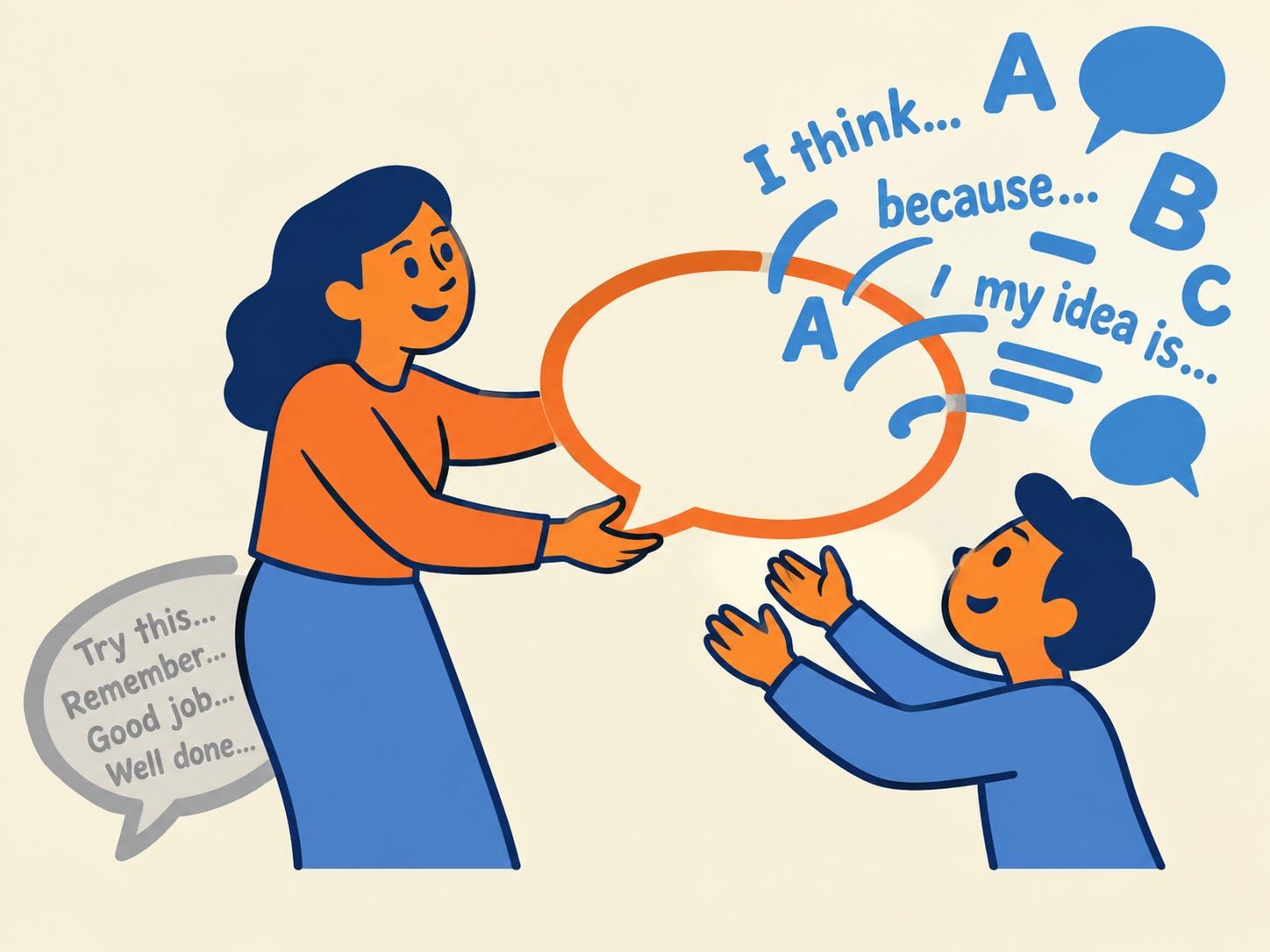
Eliciting is drawing language, ideas, or meaning (possibly all three at once!) out of your students, rather than just telling them what you want them to learn.
That’s it - you ask, they produce language, it informs the next activity.
It’s the opposite of presenting as when you present, the communication goes from teacher to student. Eliciting starts with a teacher action or question, but then is from student(s) to teacher. Different amount of work done by the students (who, let’s face it, need more practice with the language than you do).
You can elicit: grammar meaning and structure, pronunciation, instruction next steps, topic from a text, something that happened last lesson - anything you want to focus on that the students have a good chance of knowing.
Why eliciting is worth it
So why not just present? It’s quicker and easier after all.
You find out what they already know. Half the language on your plan may already be in the room. Thirty seconds of eliciting tells you. Ten minutes of presenting tells you nothing, and bores the people who knew it already.
Digging a word out is stronger than being handed one. It’s why testing yourself beats re-reading your notes. The effort is what makes it stick.
The thinking stays where it belongs. Whoever does the thinking gets the language, and eliciting is the cheapest way to hand the thinking over. Same principle as not working harder than your students.
Your talking time drops and your control doesn’t. You’re still driving, just with questions instead of statements.
It also stops you solemnly teaching “kettle” to a class who’ve been making tea in English for two years.
Why it goes wrong (and it isn’t your fault)
Most training says “elicit, don’t tell” and leaves it there. Nobody tells you what is worth eliciting, so we end up fishing for language the class hasn’t encountered.
OR, we ask a question with no context around it, so there are forty possible right answers and we’ll only accept one. What are the students playing at that point? Guess-the-word-in-the-teacher’s-head, and that’s not fun to get it wrong.
How to elicit, step by step
1. Check they’ve got a good chance of knowing it. Could a student in this room realistically produce this? If not, don’t elicit.
2. Build a context first. A situation, a picture, a short story. Set the context and the answer goes from forty possibilities to one or maybe two. “It’s snowing, I’ve forgotten my coat, look at me” gets you freezing far faster than pointing at a thermometer and hoping.
3. Make sure the context is one they care about. Curiosity, or at least plain nosiness, has to arrive before the elicitation does. Ask a bored class to produce language and you’re back to the battle of wills from the top of this article, and you’ll lose it. A topic they want to talk about does half your work before you open your mouth.
4. Ask a question that only one answer fits. This is CCQ thinking pointed at eliciting. “How do you feel?” is a conversation. “So what’s the word for very, very cold?” is an elicit. And grade your language while you’re at it, because a question they can’t decode can’t be answered.
5. Then be quiet, and count to eight. Slowly. Most failed eliciting is a teacher filling a silence that was about to produce an answer. Eight seconds feels like a fortnight when you’re standing at the front. It feels like nothing at all from a desk where someone is thinking. Remember our five eternal seconds at the top? They were three seconds short.
While you wait, look at them. Make eye contact, go round the room, and see who’s with you and who’s spinning a pen round their thumb. Staring at the board or down at your book tells the class you don’t really expect an answer. Looking at them says you do.
And if their faces tell you they were never engaged, stop counting. Eight seconds aimed at a room that isn’t listening is a battle of wills, and it ends with you leaning on the one student who always answers. That’s a crutch, and the everyone knows it.
6. Accept, shape, or tell. If it’s right, confirm it and move on. If it’s close, praise the effort before you fix it: “Well done, that’s a great effort. We do say it a bit differently.” If nothing comes after two goes, tell them. A clean model beats a long, awkward extraction, and there’s no shame in it. I’ve seen people go through verbal gymnastics to try and elicit just because they thought they had to, and waste ten minutes! Then drill it and board it as you normally would.
Make the praise public whatever comes back. The others are watching what happens to the student who spoke, and they’ll take their cue from it.
Top tips for eliciting
Nominate after the wait, not before. Ask, wait, then name a student. Name first and the other twenty switch off.
Get the meaning out of them before the form. Concept first, word second.
Don’t elicit everything. A lesson where nothing is simply told is exhausting for everyone, you included.
If you liked this article, you’ll love my books and flashcards:

📝 Lesson Planning for Language Teachers - Plan better, faster, and stress-free.
🤖 AI for Busy Teachers - A practical guide to save hours every week.
👩🎓 Essential Classroom Management - Develop calm students and a classroom full of learning.
🏰 Storytelling for Language Teachers - Use the power of storytelling to transform your lessons.
🤖 ChatGPT for Language Teacher 2025 - A collection of AI prompts and techniques to work better, faster.
💭 Reflective Teaching Practice Journal - Improve your teaching in five minutes daily.
📒 Studying? Download my DipTESOL and DELTA flashcards for Anki