

Don't Work Harder Than Your Students
Time to rethink how you're giving feedback.
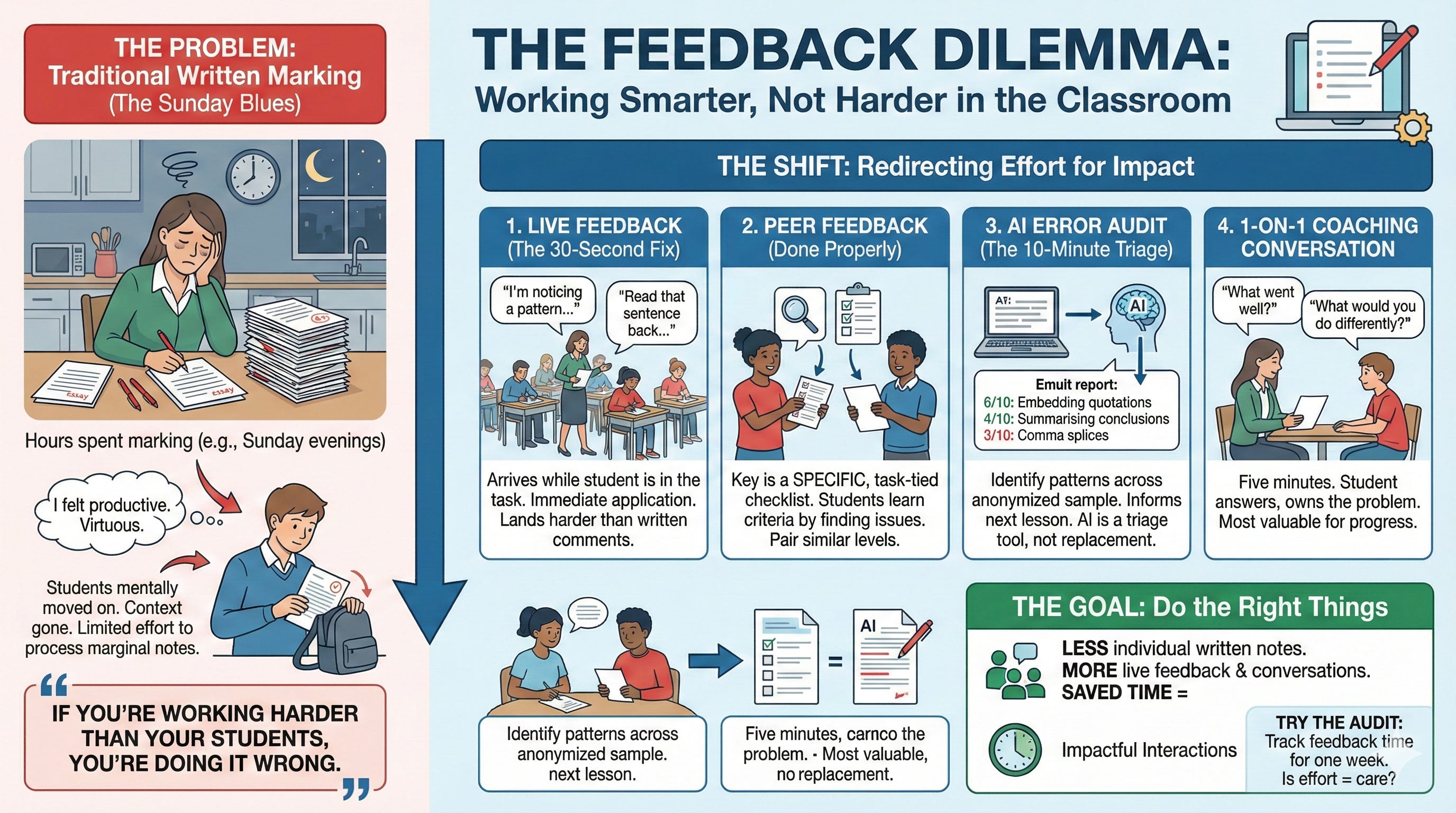
I used to spend Sunday evenings at the kitchen table with a stack of essays, a red pen, and the quiet resentment of someone who knows they should be watching television.
I’m talking two, sometimes three hours. Writing comments in the margins. Underlining things. Drawing little arrows. By the end I’d written more words than half my students had. I felt great.
And then on Monday, I’d hand the essays back and watch as students glanced at the grade, maybe read the first comment, then stuff the whole thing into their bag.
That was it. Two hours of my Sunday, and most of it never got read.
It took me years to see the problem. I was doing all the thinking. All the cognitive heavy lifting that should have been theirs. I’d identified the errors, categorised them, explained them, and suggested how to fix them. My students hadn’t had to do any of that. And so, predictably, they didn’t learn from it.
If you’re working harder than your students, you’re doing it wrong.
There. That’s the uncomfortable truth this article is built around. Let’s look at what to do instead.
Why written marking often misses the mark
There’s actually decent research on this. Written feedback tends to have limited impact when it arrives days after the work was done - the student has mentally moved on, the context is gone, and processing someone else’s marginal notes requires effort most teenagers simply won’t apply voluntarily.
But honestly, you don’t need the research. You’ve lived it.
You’ve written ‘vary your sentence structure’ on the same student’s work three times. You’ve explained comma splices in careful, patient handwriting, and six weeks later there they are again. You’ve spent twenty minutes on a thoughtful, personalised comment that the student read for approximately four seconds.
The problem isn’t your effort. It’s where the effort is going.
The system trained us to equate hours spent marking with care, with professionalism, with good teaching. But that equation is wrong. And it’s costing you your Sundays.
Live feedback: the thirty-second fix
The most effective feedback is the feedback that arrives while the student is still inside the task.
Not two weeks later. Now.
While your class is working, circulate. Don’t just check they’re on task - actually look at what they’re producing. You’ll notice patterns quickly. The same error cropping up across four or five students. When that happens, stop the class. It takes thirty seconds.
‘I’m noticing a lot of you are doing X. Let’s look at why that doesn’t quite work.’
Thirty seconds. It lands harder than three paragraphs of written commentary, because they’re still in the middle of the work. The learning is live. They can apply it immediately, which is precisely when it sticks.
You can do this individually too. A quiet word as you pass - ‘Read that sentence back to yourself’ - puts the correction back in their hands. They have to find the problem. That’s where the learning happens. Not in your margin note. In their head.
Peer feedback: done properly this time
Peer feedback has a bad reputation, and mostly it deserves it.
The standard version goes like this: students swap books, write ‘good’ or ‘could be better’ at the top, hand them back. Nobody learns anything. The teacher tells themselves it was valuable and goes home feeling vaguely guilty.
The version that actually works looks completely different. The key is a specific, task-tied checklist. Not ‘give feedback on each other’s writing’ - that’s too vague and students don’t know how. Instead: ‘Does the introduction set up a clear argument? Can you find three pieces of evidence? Is the conclusion doing something different from the opening paragraph?’
With a proper checklist, most students can do this well. And here’s the thing: finding something in someone else’s work requires you to understand what that thing is. They’re learning the criteria from the inside, not having it handed to them.
A few practical notes. Pair students at similar levels - nobody wants to hand their best effort to the strongest person in the class. Monitor carefully, especially the first few times. Challenge vague feedback out loud. ‘Good’ is not feedback. Ask them to be specific.
After a few sessions, students get surprisingly good at this. And you’ve just freed up a significant chunk of your week.
Where AI fits in: the ten-minute error audit
Here’s the workflow that changed how I approach a class set.
When students hand in written work, take a representative sample - eight to ten pieces. Remove names and any identifying details. Paste the anonymised extracts into an AI tool and ask it to identify patterns across the set. Not individual corrections. Patterns.
You might get back something like: six of the ten students are struggling to embed quotations fluently; four are writing conclusions that simply summarise rather than reflect; three are using comma splices consistently throughout.
Ten minutes. And now you have a clear picture of what the whole class needs next. That’s your next lesson, right there - built directly from their actual work, not your assumptions about what they might need.
A quick note of caution: AI won’t catch everything. It can miss nuance, misread context, and it doesn’t know your mark scheme the way you do. Your professional judgment still matters enormously - think of the AI as a first-pass triage tool, not a replacement for your expertise. Always review what it gives you.
But used well, it gives you something genuinely valuable: time back. And this is what you do with that time.
The 1-on-1 coaching conversation
This is the part I wish someone had told me earlier in my career.
Five minutes. One student. Their work in front of you.
Start with: ‘What do you think went well here?’ Let them answer properly. Then: ‘What would you do differently?’ Let them answer again.
You will be surprised. Students know far more about their own weaknesses than we give them credit for. When they say it out loud themselves - rather than reading it in your handwriting - something shifts. They own it. It becomes their problem to fix, not yours.
This is what the saved time is for. Not more written comments. Not more margin notes that go in the bag. A real conversation, face to face, where you find out what’s actually going on for that student.
You don’t need to do it with everyone every week. Pick two or three per lesson. Work through the class over a fortnight. Keep a simple note after each one so you remember where each student is. Over time, these conversations become the most valuable thing you do for their progress.
It’s also, incidentally, the thing no AI tool can replicate. That’s worth holding onto.
Try the audit yourself
Before changing anything, spend one week tracking where your feedback time actually goes. A rough log is fine - five minutes at the end of each day. How long did you spend marking? What did students do with that feedback? How many of your comments were individual written notes that only one person would ever read?
Most teachers who do this are genuinely surprised. Not because they’ve been doing anything wrong, but because the system tells a persuasive story: effort equals care. More marking equals better teaching. Except your experience doesn’t actually support that, does it?
The goal isn’t to do less. It’s to do the right things.
Live feedback during tasks. Structured peer review with a real checklist. A ten-minute AI error audit instead of three hours of individual written comments. And the time you save redirected into the conversations that only you can have.
Work smarter than your students. Not harder.
If you liked this article, you’ll love my books:

📝 Lesson Planning for Language Teachers - Plan better, faster, and stress-free.
👩🎓 Essential Classroom Management - Develop calm students and a classroom full of learning.
🏰 Storytelling for Language Teachers - Use the power of storytelling to transform your lessons.
🤖 ChatGPT for Language Teacher 2025 - A collection of AI prompts and techniques to work better, faster.
💭 Reflective Teaching Practice Journal - Improve your teaching in five minutes daily.
I do 4 days of 1:1 feedback conversation after each essay. I love it! No more wasted weekends grading essays, and the students actually hear the feedback.