

How to Use CCQs and ICQs (Without Overthinking It)
Why your students say yes and but still get it wrong.
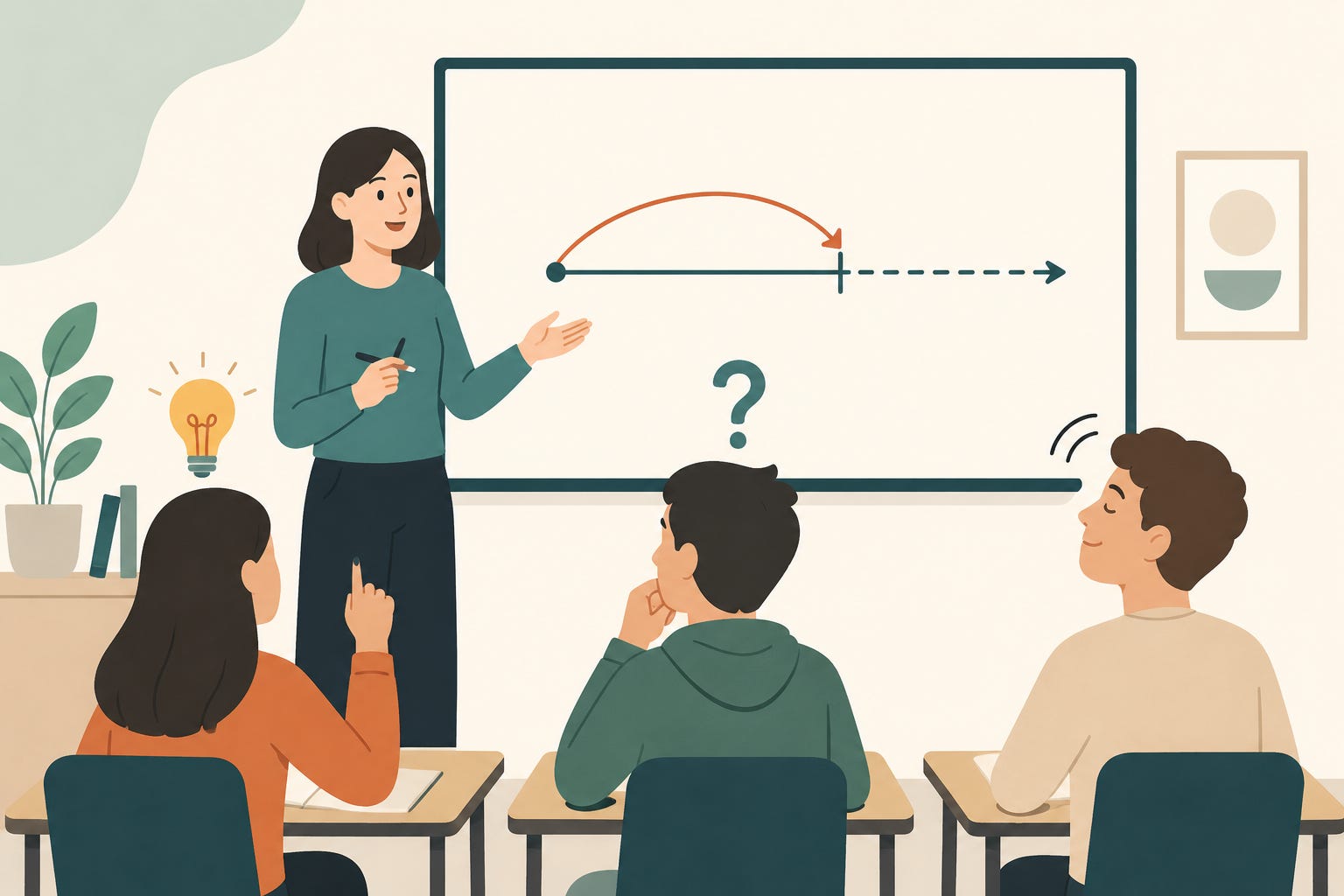
You finish explaining the present perfect (again). You’ve drawn a timeline, given three examples, and even colour-coded the board. You ask, “Does everyone understand?”
Everyone nods. Nice.
Then you set the task, give instructions, walk around to monitor, and find half the class using the past simple. You say a naughty word in your head - the nods meant nothing, they never do.
That gap between “they nod” and “they actually get it” is what CCQs and ICQs are created for. They’re two of the best techniques in teaching, and most of us either skip them or mess them up. Let’s take a look at how to do them properly.
What CCQs and ICQs actually are
They sound similar and get muddled constantly, but they do two different jobs.
CCQs are concept checking questions. They check that students understand the meaning of the language you’ve just taught. Did they grasp what the present perfect actually communicates, or just how to form it?
ICQs are instruction checking questions. They check that students know what to do in the task you’ve just set. Are they working alone or in pairs? How long have they got? What do they do when they finish?
One checks understanding of language. The other checks understanding of instructions.
Why “do you understand?” doesn’t work
Students say yes for an easy life.
They nod because they don’t want to look stupid in front of their classmates. They nod because they think they understand, right up until they have to use it. They nod because saying “no” feels like admitting they weren’t listening.
A good checking question forces a demonstrable answer. The student either knows it or they don’t, and now you can see which. You’ve swapped a polite reflex for actual evidence.
How to write a good CCQ
Here’s the method, and it’s simpler than it looks. Break the concept down into its component parts, then turn each part into a short question.
Take the present perfect in “I’ve lost my keys.” The concept is roughly: it happened in the past, you don’t know exactly when, and it matters now because the keys are still lost.
So you’d ask:
Did I lose the keys in the past? (Yes)
Do I know exactly when? (No)
Do I have the keys now? (No)
Three quick questions, three short answers, and now you actually know whether the concept landed.
The rules that make this work:
Keep them answerable in one or two words. Yes, no, a number, a single noun.
Don’t use the target language to check the target language. Asking “Has the action been completed in the recent past?” to check the present perfect just tests whether they understand your question.
Use language simpler than the thing you’re checking. If the question is harder than the grammar, you’ve created a new problem.
Be specific. Each question should check one thing you actually care about.
Common CCQ mistakes
The biggest one is asking questions that are harder than the original point. If a student needs to understand the present perfect to understand your concept check, the check is useless.
The second is using “why.” Ask “Why do we use the present perfect here?” and you’ll get silence, because explaining grammar in a foreign language is a much bigger ask than understanding it. CCQs test the concept, not the metalanguage.
And then there’s the classic. A teacher tries to concept check the word “cat” by asking, “What’s the opposite of a dog?” The student thinks hard and answers, “No dog?” Bright kid. Wrong question. Think your CCQs through before you walk in.
How to use ICQs
ICQs are the easier sibling. They don’t check meaning, they check that students know what they’re meant to be doing.
You’ve just set a task: “In pairs, write five questions you’d ask in a job interview. You’ve got five minutes.” Before you release them, you check the mechanics:
Are you working alone or in pairs? (Pairs)
How many questions? (Five)
How long have you got? (Five minutes)
Thirty seconds, and you’ve prevented the scene where three students sit in confused silence while the rest start the wrong activity. ICQs are especially worth it with lower levels, complex multi-step tasks, and any instruction you’ve just given in English to students who weren’t fully listening.
When not to bother
Not everything needs checking, and over-checking is its own problem.
If you’ve just told students to open their books to page 40, you don’t need an ICQ. If the vocabulary is a transparent cognate they obviously understand, skip the CCQ. Concept checking a word your students clearly know wastes time and quietly patronises the stronger ones.
The skill isn’t asking checking questions constantly. It’s having a feel for which concepts and instructions are likely to trip students up, and checking those. Treat it as judgement, not ritual.
A quick template you can reuse
When you’re planning and you hit something worth checking, run it through this:
What’s the concept or instruction?
Break it into 2 to 4 component parts.
Turn each part into a short question with a one or two word answer.
Check: is any question harder than the thing I’m checking? If so, simplify.
Do this a few times during planning and it becomes automatic. Eventually you’ll generate decent CCQs on the spot, but until then, a couple of minutes at the planning stage saves you a confused class later.
The bottom line
Checking questions turn “they nodded” into “they showed me.” That’s the whole point. You stop guessing whether learning happened and start getting evidence, one short answer at a time.
It costs you a little planning time and a few seconds in class. In return, you teach to what students actually understand instead of what you hoped they did.
If you want to build concept checking into your planning more systematically, I go deeper on it in Lesson Planning for Language Teachers, alongside the other stages where checking understanding makes or breaks a lesson.
If you liked this article, you’ll love my books:

📝 Lesson Planning for Language Teachers - Plan better, faster, and stress-free.
🤖 AI for Busy Teachers - A practical guide to save hours every week.
👩🎓 Essential Classroom Management - Develop calm students and a classroom full of learning.
🏰 Storytelling for Language Teachers - Use the power of storytelling to transform your lessons.
🤖 ChatGPT for Language Teacher 2025 - A collection of AI prompts and techniques to work better, faster.
💭 Reflective Teaching Practice Journal - Improve your teaching in five minutes daily.