

What is Comprehensible Input?
What Krashen got right, what he got wrong, and what to do about it.
Before you read: don’t forget to download my DipTESOL and DELTA flashcards.
Someone tells you they lived abroad for three years and never picked up the language. They heard it every day. Shops, buses, television, colleagues talking across the office. Thousands of hours of exposure, and only a few basic phrases to show for it.
So... if exposure to the language wasn’t the problem, what was? Answer = a lack of understanding.
The gap between exposure and understanding sits behind one of the most influential, and most argued-over, theories in language teaching.
Let’s look at where the idea comes from, what it gets right, where it falls apart, and, most importantly, what you should actually do with it in your classroom.
Where did this idea come from?
Stephen Krashen proposed the Input Hypothesis in the early 1980s, as part of a wider set of claims about how second languages are learned. His argument was simple. We acquire language when we understand messages that contain language slightly beyond our current level.
He wrote it as a formula: i + 1. The i is the learner’s current level. The + 1 is the small step beyond it. Input at that level is comprehensible because context, visuals, gesture, and what the learner already knows all fill the gap that the language alone leaves.
Krashen’s bolder claim was that this is the only way acquisition happens. Not through studying rules. Not through drills. Through understanding, and nothing else.
What counts as comprehensible input?
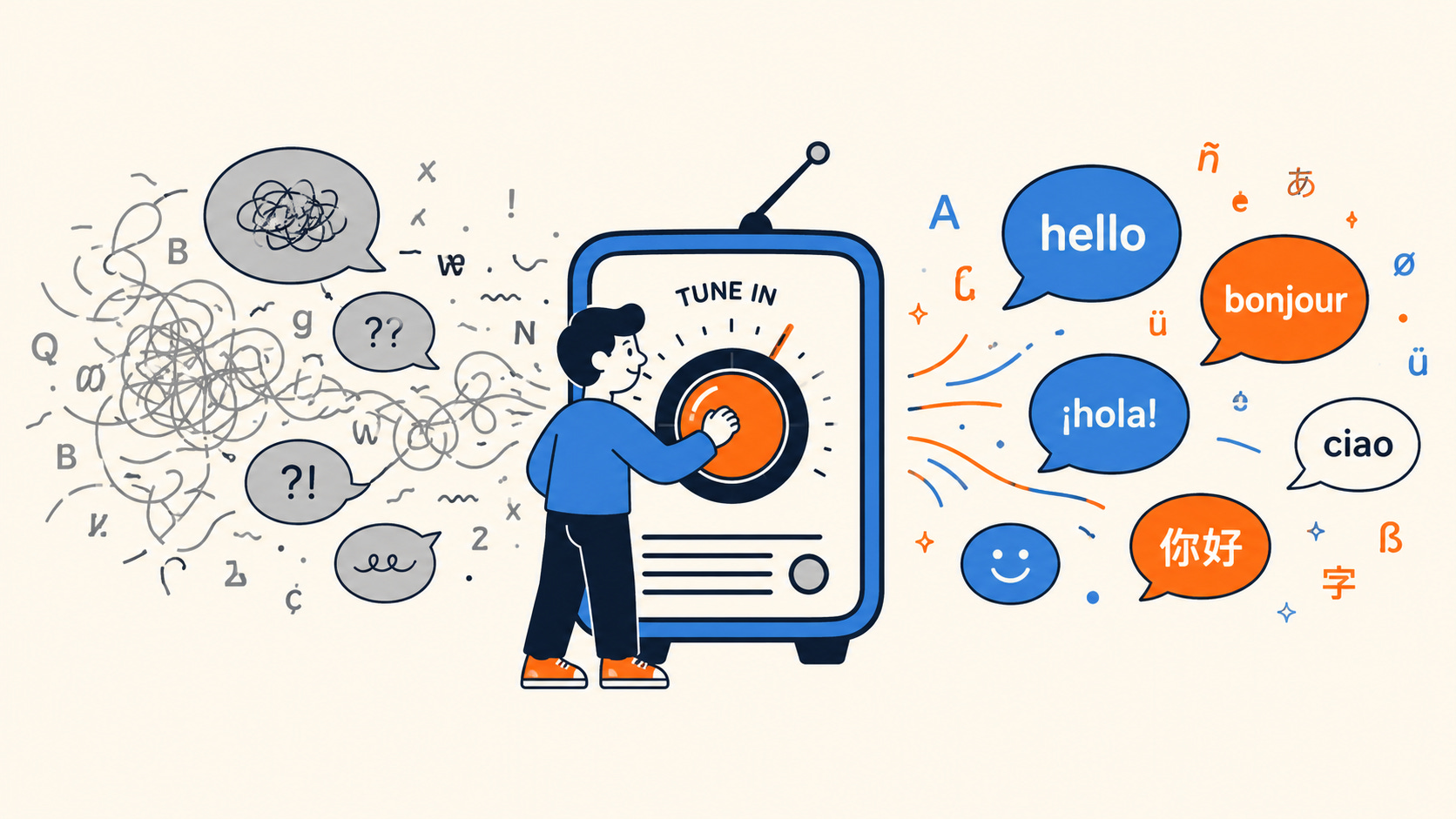
Think of it like tuning a radio. Blast pure static and you get nothing. Land right on the station and it all makes sense. i + 1 is the station just past where you’re comfortable, close enough to lock onto, far enough that you have to reach.
So comprehensible doesn’t mean easy. Input a learner already understands completely gives them nothing new to acquire. Input far beyond their level gives them nothing they can process. The useful zone is narrow, and context does most of the work:
A teacher narrating a demonstration while learners watch.
A graded reader pitched so the unknown words are rare enough to guess.
A video where the images carry meaning the soundtrack can’t.
In all three, learners understand more than the language on its own would allow. That’s the whole trick.
What does the theory get right?
Quite a lot, actually.
Learners need volume. A lot of it. The research on extensive reading and listening is consistent on this, and it’s one of the most reliable findings in the whole field.
It shifted where we spend our time. Before the Input Hypothesis, classroom minutes went heavily on practising forms. After it, teachers had a reason to prioritise meaning, and to spend time on things learners actually wanted to read and hear.
It explains something you’ve probably seen. Some learners acquire a great deal of language with no formal instruction at all, purely through exposure they understand. We’ve all met that person.
So what’s wrong with it?
The theory has some serious problems.
i + 1 can’t be measured. Nobody can pin down a learner’s exact level precisely enough to know what sits one step beyond it. That makes the hypothesis very hard to test, and a claim you can’t test is a shaky foundation. (Good teachers do sense this zone, to be fair, but by gut feel, not by anything measurable.)
Input alone doesn’t seem to be enough. The clearest evidence comes from the Canadian French immersion programmes. Students spent years soaking up enormous amounts of comprehensible input. Their listening comprehension became excellent. Their grammatical accuracy did not, and certain errors stuck around for years.
Merrill Swain’s Output Hypothesis came straight out of those findings. Her argument was that producing language forces learners to process it in ways comprehension never does. You can understand a sentence without noticing how it’s built. You can’t produce one without confronting exactly that.
Richard Schmidt’s work on noticing points the same way. Learners seem to need conscious attention to features of the language, not just exposure to them.
And Krashen’s neat split between acquisition and learning, with the claim that conscious learning never turns into acquisition, is now widely rejected.
Where does the idea stand now?
These days, comprehensible input is treated as necessary but not sufficient. Almost nobody argues that learners can acquire a language without large amounts of understandable exposure. And almost nobody argues that exposure on its own is enough.
The idea lives on in extensive reading programmes, in TPRS, and in a big community of CI-focused teachers. Some of that work holds to a purer version of the theory than the research really supports, but the underlying practice is sound, and the sheer volume of input those approaches deliver is genuinely useful.
What this means for your classroom
Here’s where it gets practical. Five things to take away:
Grade your language, don’t strip it out. Slow down, repeat, rephrase, choose common words. Don’t remove everything unfamiliar, because the unfamiliar part is where the learning happens.
Let context carry the weight. Visuals, gesture, realia, demonstration, and situations your learners already recognise all make harder language accessible. Setting a strong context does more of the heavy lifting here than almost anything else.
Build in extensive reading and listening. Learners can’t get enough input from lessons alone. This is where the volume comes from.
Check comprehension, don’t assume it. Learners nod. Nodding is not understanding.
Give them reasons to produce, and feedback on what they produce. Input builds comprehension. Output and attention to form build accuracy. You need both.
The short version
The person who spent three years abroad and learned nothing was surrounded by input. Almost none of it was comprehensible to them, so almost none of it counted.
Comprehensible input explains a huge chunk of how languages are learned. Not all of it. Treat it as the engine, not the whole car. Give your students mountains of input they can understand, then make them do something with it.
Teachers who grasp both the strength of the idea and its limits use it well. Teachers who swallow it whole end up with learners who understand a great deal and can say very little.
If you liked this article, you’ll love my books:

📝 Lesson Planning for Language Teachers - Plan better, faster, and stress-free.
🤖 AI for Busy Teachers - A practical guide to save hours every week.
👩🎓 Essential Classroom Management - Develop calm students and a classroom full of learning.
🏰 Storytelling for Language Teachers - Use the power of storytelling to transform your lessons.
🤖 ChatGPT for Language Teacher 2025 - A collection of AI prompts and techniques to work better, faster.
💭 Reflective Teaching Practice Journal - Improve your teaching in five minutes daily.