

Three Years Later: AI in Education Revisited
Let's look at what's happened in the last three years.
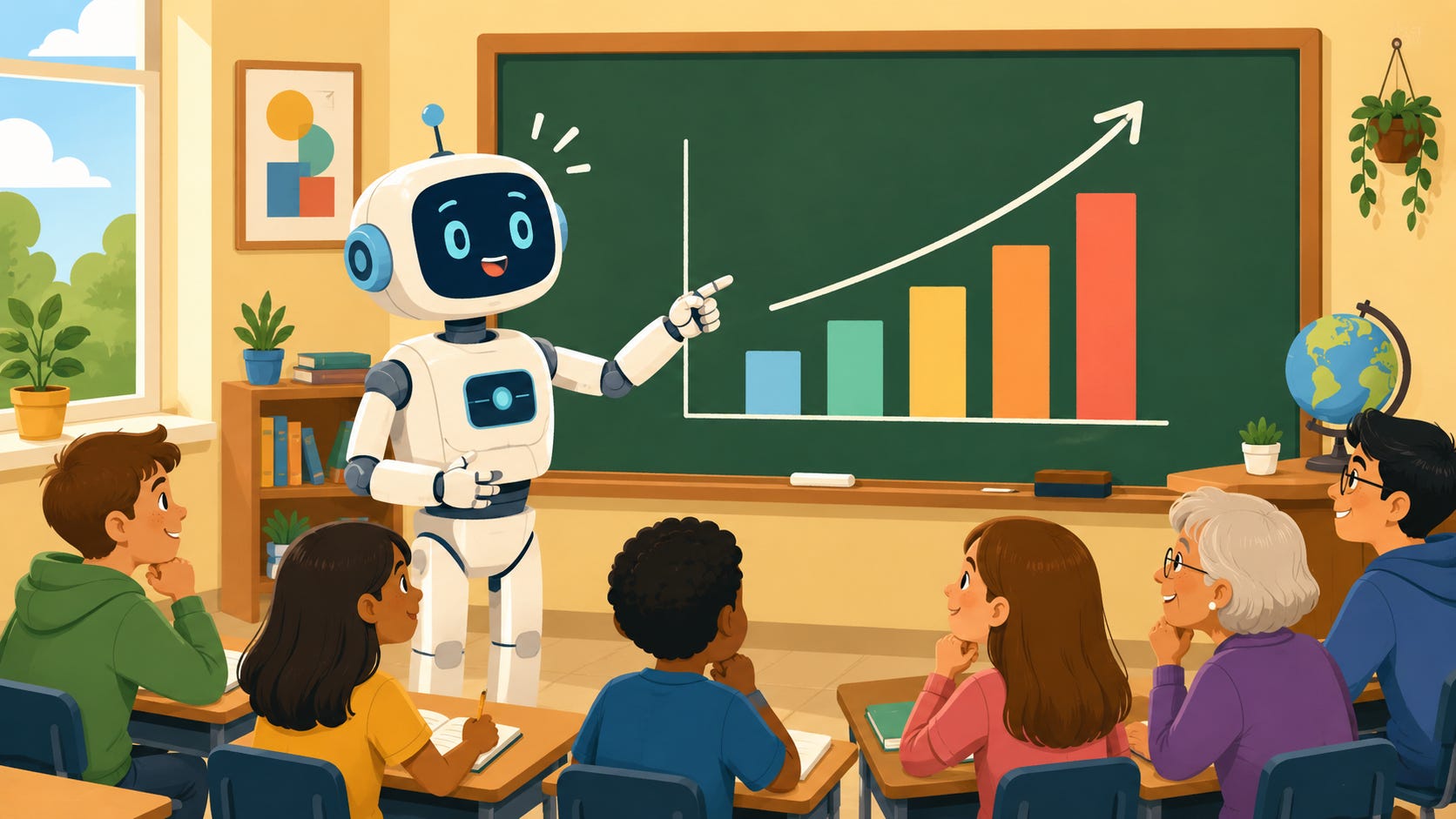
Three years ago I wrote an article called The Next Three Years: AI & Education. I made twenty predictions - eleven about where AI in education was heading, and nine about the challenges we’d face along the way.
I’m going to hold myself accountable.
Some of what I predicted came true. Some came true faster than I expected. A few things moved more slowly than I thought. And one or two I got badly wrong.
Here’s the full report card - followed by where I think things go from here.
Part one: The predictions revisited
1. AI will integrate with everything
Verdict: Right - and faster than I expected.
I predicted AI would pair with learning management systems, school management tools, and curriculum design. That’s happened. Canvas, Google Classroom, and Moodle now have AI features baked in. AI-powered LMS platforms don’t just deliver content anymore - they personalise learning, automate admin, predict learner outcomes, and generate curriculum in real time.
According to a 2025 Microsoft Education report, 83% of K-12 teachers now use generative AI tools - for planning, feedback, and content support. This isn’t a fringe interest anymore. It’s mainstream and accelerating.
2. New mega-learning companies will appear
Verdict: Partially right - but messier than I predicted.
I imagined a few dominant new giants. What actually happened was an explosion of specialised startups. MagicSchool AI reached 2.5 million teachers. Squirrel AI now serves over 15 million students across 60,000 schools. The global EdTech market hit $300 billion in 2024.
The “next big thing” arrived in fragments, not as one giant. Lots of smaller companies moved fast and filled gaps that the big players were too slow to address. Exactly as I predicted - just with more of them than I imagined.
3. Ethical issues will divide opinion
Verdict: Right - and it’s got messier, not cleaner.
I saw this one coming, but I underestimated how quickly the ethical conversation would multiply. Three years ago, most of the debate was about cheating and academic integrity. Now it’s that plus data privacy, algorithmic bias, equitable access, surveillance, and questions about what education is even for.
No consensus has emerged. If anything, the gaps have widened - between those who see AI as the future and those who see it as a threat. We’ll come back to this.
4. There will be ongoing debates
Verdict: Right.
Countries, states, and schools have developed wildly different responses. Some embraced AI. Some banned it. Some banned it, then unbanned it (NYC, I’m looking at you). As of July 2025, most public schools in the US still had no formal AI policy for students.
The debate hasn’t been resolved. It’s just got louder.
5. Learning will become individualised
Verdict: Partially right - the technology is there, the classroom reality lags.
This is the one where I have to split the verdict carefully. The technology works. A 2025 randomised controlled trial published in Scientific Reports found that AI tutoring outperformed in-class active learning, with an effect size of between 0.73 and 1.3 standard deviations. In controlled settings and well-resourced schools, personalised AI learning is genuinely happening.
But in ordinary state classrooms - the ones most teachers work in - widespread individualised AI learning is still patchy. The potential is real. The practice doesn’t yet match the promise.
6. Intelligent tutoring systems will appear
Verdict: Right - and “appear” was an understatement.
A 2025 systematic review of AI-driven tutoring systems in K-12, drawing on 28 studies with nearly 5,000 students, found generally positive effects on learning outcomes. Khan Academy’s Khanmigo. Squirrel AI. Century Tech. These aren’t experiments anymore - they’re deployed at scale and they work.
If I’d known how fast this would move, I’d have said it more boldly.
7. There will be immersive educational experiences
Verdict: Partially right - but not yet in most classrooms.
I imagined students having real-time virtual conversations with people from other cultures. The technology to do this largely exists. The VR in education market was valued at over $20 billion in 2025 and is projected to reach $83 billion by 2034.
But the specific vision I had - AI-powered immersive language learning as a classroom reality - is still mostly aspirational. It’s happening in specialist settings and corporate training. In the average language classroom, it’s not. This one still has a way to go.
8. Education will become more accessible
Verdict: Right.
This might be the quietest success story of AI in education. Speech recognition, text-to-speech, real-time translation, AI captioning - these tools have improved dramatically and are now genuinely useful for learners with disabilities and multilingual learners. Some platforms now support AI-powered translation across 60+ languages.
I got this one right. It doesn’t get enough attention.
9. Administration tasks will be automated
Verdict: Right - and teachers are noticing.
A June 2025 Gallup and Walton Family Foundation survey of over 1,000 teachers found that those using AI tools at least weekly save an average of 5.9 hours per week - roughly six weeks of reclaimed time across a school year. Lesson planning, grading, feedback, scheduling - all being partially automated.
This is probably the most tangible win for classroom teachers so far. Not the flashy stuff. The time-saving stuff that actually changes your working week.
10. Predictive analytics will be used
Verdict: Right.
AI platforms can now identify at-risk learners early and intervene before students fall behind. I mentioned Big Brother in my original article - and the concern stands. The capability is real and widely deployed. The ethical questions around it remain wide open.
Right prediction. Unresolved problem.
11. Assessment and feedback will improve
Verdict: Right.
AI grading, instant written feedback, and adaptive testing are now standard features of the better platforms. Whether this represents genuine pedagogical improvement, or just faster processing of old-fashioned assessments, is a fair debate. But the tools exist, teachers are using them, and students are getting faster feedback than they were three years ago.
Part two: The challenges revisited
1. Data privacy
Verdict: Confirmed - and still unresolved.
I flagged this, and it’s got worse. AI systems in schools are now collecting more student data than ever - learning behaviours, performance patterns, engagement levels. Regulatory frameworks are still catching up. The concern I raised three years ago is bigger now, not smaller.
2. Equity and access
Verdict: Confirmed - and possibly getting worse.
Here’s the uncomfortable truth: banning AI in schools may actually widen the gaps those schools are trying to close. Wealthier students with AI tools at home will keep using them regardless. Students in underfunded schools where AI is banned will fall further behind.
The digital divide was a problem before AI. AI has added a new layer to it.
3. Bias in AI
Verdict: Confirmed - no clean solution yet.
AI models trained on vast datasets reflect the biases in those datasets. Students from non-dominant cultural and linguistic backgrounds are often disadvantaged by AI systems that reflect pre-existing biases, reinforcing stereotypes rather than correcting them. This is well-documented and no one has fixed it.
4. Dehumanised education
Verdict: Concern confirmed, catastrophe avoided - so far.
The anxiety remains real, and I still share it. But the dominant direction of travel has been AI-as-assistant rather than AI-as-replacement. Most of the evidence suggests teachers are using AI to free up time for the human parts of the job - connection, mentorship, conversation.
Whether that holds at scale is the open question. I’m cautiously optimistic. But I’m watching.
5. Over-reliance on technology
Verdict: Confirmed - and sharper than I expected.
A January 2026 national survey found that 95% of college faculty feared student overreliance on AI and diminished critical thinking. Ninety-five percent. That’s not a minority concern - that’s near-universal alarm among educators.
This isn’t theoretical anymore. Teachers are seeing it daily. Students submitting AI-generated work that they clearly haven’t read. Students who can’t write a sentence without a tool to do it for them. This challenge landed harder than I anticipated.
6. Training for teachers and students
Verdict: Confirmed - still a significant gap.
Districts announced AI training plans. Many didn’t follow through. A 2026 analysis found that 85% of teachers feel unprepared to manage AI in their classrooms, with 32% saying they are completely unprepared. A lot of teachers are still not using AI, or are using it poorly, through no fault of their own.
This is fixable. It hasn’t been fixed.
7. Job security
Verdict: Concern confirmed, but reality has been slower than feared.
A Pew Research Centre study found that nearly a third of AI experts predict AI will place teaching jobs at risk over the next twenty years. But mass job losses haven’t happened yet. The profession is changing, not disappearing - at least for now.
I said in my original article that government school teachers would probably be safe for a while, but that private sector and language teaching jobs might not be. I still think that. The private tutoring market is where AI will bite first. It already is, quietly.
8. Ethics and morality
Verdict: Confirmed - and academic integrity has become the main battleground.
Cheating, AI-generated essays, and the collapse of traditional assessment have become the dominant ethical issue in classrooms. My Gattaca reference still holds - predictive profiling of students is happening and the implications haven’t been worked through.
The tools moved faster than the ethics.
9. Regulation and policy
Verdict: Confirmed - still a mess.
Three years on, most public schools still have no AI policy for students. No settled global framework exists. Different countries, different states, different schools - all doing different things, mostly reactively.
The knee-jerk bans I predicted happened. So did the reversals. The grown-up policy conversation is still waiting to happen.
Part three: What three years taught me
The technology moved faster than the institutions.
This is the headline finding. The tools arrived faster than anyone - including me - anticipated. What didn’t keep pace was everything else: teacher training, ethical frameworks, regulatory policy, classroom practice. We have powerful AI in education. We don’t yet have a good answer to the question of what we’re actually supposed to do with it.
The classroom reality lags behind the hype.
Read the EdTech press and you’d think every classroom in the world is running personalised AI learning pathways. Visit an ordinary state school and the picture is more complicated. Lots of teachers are saving time on admin. Fewer are transforming how they teach. The gap between what’s possible and what’s actually happening in most classrooms is still wide.
The ethical questions got louder, not quieter.
I expected the ethical debates to evolve into clearer positions over time. Instead, they’ve proliferated. Cheating. Privacy. Bias. Dependency. Job security. Equity. Each of these is more live now than it was three years ago. We’re not closer to answers. We’re just more aware of the questions.
Part four: Where we are now
Here’s what AI in education actually looks like for a working teacher in 2025 - not the press release version, the real one.
If you’re teaching in a well-resourced school with forward-looking leadership, AI has probably changed your working week. You’re spending less time on lesson planning, grading admin, and written feedback. You might be using AI-powered tools to differentiate for your students. Your institution has probably said something official about AI, even if it’s not entirely clear.
If you’re in a state school with limited budgets and no dedicated training time, the picture is different. You might be using AI personally - for planning, for generating materials, for saving time. But it probably hasn’t changed how your students learn. And you’re almost certainly fielding AI-generated student work without a reliable way to address it.
The honest summary: AI has transformed teaching more than learning, so far. The biggest gains have been on the teacher’s side of the desk - time, efficiency, resource creation. The transformation of the student experience is still a work in progress.
That’s about to change. Quickly.
Part five: Predictions for the next three years
1. The classroom gap will start to close
The tools are ready. What’s been missing is training, confidence, and time. Over the next three years, as teacher training programmes catch up and more schools invest in AI literacy for their staff, the gap between what’s possible and what’s happening in ordinary classrooms will shrink. Not disappear - but shrink noticeably.
2. A new EdTech giant will consolidate the market
The current landscape - hundreds of competing AI education startups - isn’t stable. We’ll see significant consolidation. Either one dominant platform will emerge, or a major acquisition will create a genuine market leader. The money is in the sector. The gravity of consolidation is pulling.
3. The cheating crisis will force a redesign of assessment
AI-generated essays have broken traditional written assessment. Schools can’t detect it reliably and can’t stop it. The solution isn’t better detection - it’s different assessment. Expect a significant shift toward oral exams, project-based assessment, in-person evaluation, and tasks that AI can’t do for you. This will be uncomfortable and slow, but it will happen.
4. AI tutoring will start to dent private tutoring markets
This one is personal for many language teachers. AI tutors are already cheaper, always available, infinitely patient, and improving fast. In the private tutoring market - especially for exam preparation and language learning - AI will take real market share over the next three years. Not all of it. But enough to be felt.
5. Personalised learning will finally arrive in mainstream classrooms
The 2025 trials showed it works. The next three years will see AI-personalised learning move from pilot programmes into more ordinary schools. This is genuinely exciting - not as a replacement for teachers, but as a tool that makes real differentiation possible at scale for the first time.
6. A major data scandal will force regulation
The regulatory gap can’t last forever. It will take a significant incident - a data breach, a bias scandal, a predictive profiling story - to force governments to act. I expect it in the next three years. And when it comes, the regulatory response will be fast and possibly overreaching.
7. AI literacy will become a core skill - for teachers and students
Knowing how to use AI tools effectively, critically, and ethically is going to become a baseline professional skill for teachers, not an optional extra. The same is true for students. Schools that get ahead of this will have a genuine advantage. Schools that don’t will struggle to prepare their students for the world outside the classroom.
8. The dehumanisation debate will intensify
As AI becomes more embedded in education, the backlash will grow. Expect a louder movement arguing for AI-free schools, for the irreplaceable value of human teaching, for protecting childhood from algorithmic optimisation. This argument deserves to be taken seriously. The question isn’t whether AI belongs in education - it does. The question is where the limits are.
9. Immersive language learning will finally go mainstream
VR-powered language practice - real-time conversation with AI characters, simulated cultural immersion, interactive speaking environments - will move from specialist tool to mainstream classroom resource within three years. The technology is there. The price is falling. For language teachers, this is the one to watch.
Closing
Three years ago, I was cautiously optimistic. I still am - but with more caveats.
AI has delivered real benefits for teachers. Time saved. Better resources. Tools that actually work. That matters. But the deeper transformation of learning - the part where every student gets genuinely personalised, effective, human-centred education - is still ahead of us.
The next three years will be the critical ones. Not because the technology will arrive - it’s already here. But because the decisions we make now, as teachers, as institutions, and as a profession, will shape whether AI makes education better or just faster.
I’ll check back in. I’ll hold myself accountable again.
What do you think? Has your experience matched mine? Let me know in the comments.
If you liked this article, you’ll love my books:

📝 Lesson Planning for Language Teachers - Plan better, faster, and stress-free.
🤖 AI for Busy Teachers - A practical guide to save hours every week.
👩🎓 Essential Classroom Management - Develop calm students and a classroom full of learning.
🏰 Storytelling for Language Teachers - Use the power of storytelling to transform your lessons.
🤖 ChatGPT for Language Teacher 2025 - A collection of AI prompts and techniques to work better, faster.
💭 Reflective Teaching Practice Journal - Improve your teaching in five minutes daily.