

Is Your Warmer Killing Your Lesson?
When the warm-up does more harm than good.
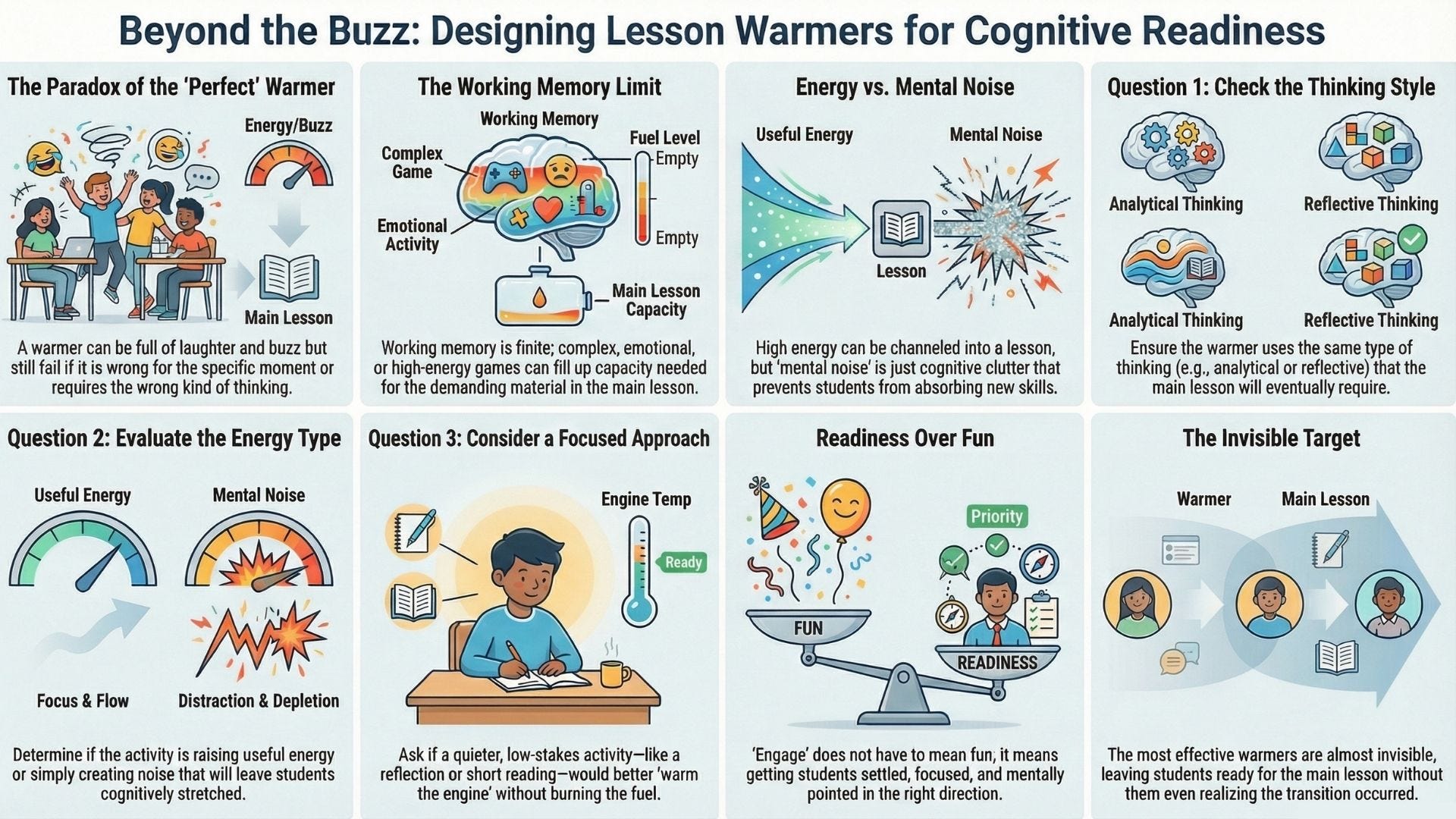
You’ve planned a fun warmer. Students are laughing, chatting, buzzing. Then you move into the main lesson - and it dies. Not because the warmer was bad. Because it was wrong for that moment.
This happens more often than teachers realise, and it rarely gets diagnosed correctly. The lesson gets blamed. The material gets blamed. Sometimes the students get blamed. The warmer - which everyone enjoyed - escapes scrutiny entirely.
What the ‘Engage’ phase is supposed to do
The logic behind starting with an engaging activity is sound. Get students talking. Lower the affective filter. Activate prior knowledge. Build a bridge between where they are when they walk in and where you need them to be.
Done well, it works. A well-chosen warmer genuinely does smooth the path into a lesson. The problem isn’t the concept - it’s the execution, and specifically the timing.
When it backfires
Some warmers ask too much of the wrong kind of thinking. A high-energy game, a creative discussion, an emotionally involving debate - these can be genuinely engaging. They can also fill up a student’s working memory before the lesson has properly started.
The result is a class that arrives at your main activity already cognitively stretched. They look switched on - they were just laughing, after all - but they’re not ready to take in new and demanding material. They’re running on fumes.
A quick word on cognitive load
You don’t need to go deep into the research to find this useful. The practical version is simple: working memory has limits. It can only hold and process so much at once. When a warmer demands a lot of creative, emotional, or complex thinking, it uses up capacity that the main lesson needs.
This isn’t an argument against warmers. It’s an argument for choosing them carefully, with the cognitive demands of the whole lesson in mind - not just the first five minutes.
The mis-timing problem
Most warmers aren’t wrong in themselves. They’re wrong for that lesson, on that day, in that slot.
A lively debate activity might be a perfect end-of-week task when students need energy and the pressure is off. Put it before a lesson introducing complex grammar or a difficult new skill, and you’ve set yourself up for a wall of blank faces twenty minutes in.
The energy spike is real. But energy isn’t the same as readiness. And that distinction matters.
What to ask before you plan a warmer
Three questions worth getting into the habit of asking:
Does this warmer use the same type of thinking the main lesson will need? If the lesson requires careful, analytical attention, a chaotic group game is probably not the right lead-in - even if it gets students talking.
Does it raise energy or raise mental noise? There’s a difference. Energy can be channelled. Mental noise is just clutter.
Would a quieter, more focused activity serve this lesson better? Sometimes the right warmer is something calm and low-stakes - a short reading, a quick reflection question, a familiar task that asks just enough to warm the right engine without burning the fuel.
The reframe
“Engage” doesn’t have to mean fun. It means ready.
Fun is a bonus. Readiness is the point. A warmer that gets students settled, focused, and mentally pointed in the right direction will serve a lesson far better than one that generates noise and laughter but leaves them poorly positioned for what comes next.
The best warmers are almost invisible. Students don’t leave them feeling like they’ve done an activity - they leave them pointed at the lesson, without quite knowing how they got there.
That’s the target worth aiming for.
If you liked this article, you’ll love my books:

📝 Lesson Planning for Language Teachers - Plan better, faster, and stress-free.
🤖 AI for Busy Teachers - A practical guide to save hours every week.
👩🎓 Essential Classroom Management - Develop calm students and a classroom full of learning.
🏰 Storytelling for Language Teachers - Use the power of storytelling to transform your lessons.
🤖 ChatGPT for Language Teacher 2025 - A collection of AI prompts and techniques to work better, faster.
💭 Reflective Teaching Practice Journal - Improve your teaching in five minutes daily.