

How to Teach Online, Step by Step
How to teach online for TEFL Teachers
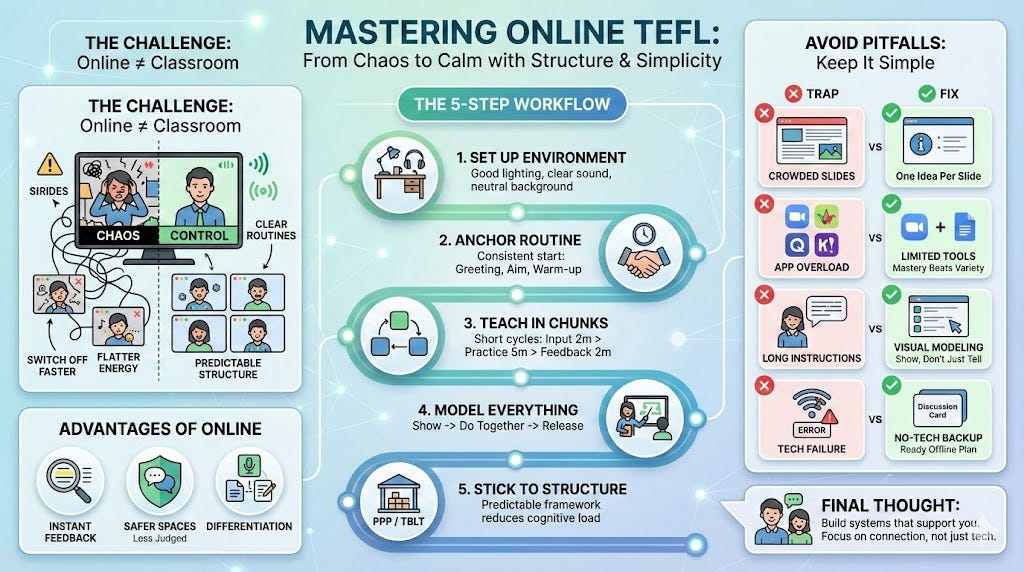
The first time you teach online, it usually feels like trying to run underwater.
You feel the resistance. The awkward silences are louder. The technology feels like a wall between you and the students. You try to replicate your dynamic in-person lessons, but the energy just doesn’t transfer.
Here is the hard truth: You cannot copy and paste your physical classroom into a webcam.
When teachers feel “lost” online, it is almost always because they are fighting the medium rather than working with it. But there is a simpler way. By shifting your mindset from “entertainer” to “facilitator,” you can replace the chaos with calm.
The webcam fallacy
Online teaching is its own unique ecosystem.
In a physical room, you rely on micro-cues: a confused glance, a shifting posture, the “hum” of the room. Online, those cues are gone. Your charisma is flattened by a screen. As a result, cognitive load is much higher for everyone.
If your instructions are slightly vague in person, students figure it out. If they are vague online, the lesson stops dead.
To survive, you must strip everything back:
Simplify your activities.
Standardise your structure.
Shrink your toolkit.
Why this is actually good news
It sounds restrictive, but limitations breed creativity. Online teaching actually offers specific superpowers that physical classrooms lack.
The “Introvert Advantage”: In a physical class, loud students dominate. Online, the Chat Box is the great equalizer. It allows shy students to answer without the terror of speaking up.
Precision Feedback: Using annotation tools on a shared screen allows you to highlight language issues instantly and visually.
Safety: A teenage student once told me she preferred online breakout rooms because she felt “less judged” than standing up in front of thirty peers. When anxiety drops, acquisition rises.
The blueprint: a 5-step workflow
You don’t need to be a tech wizard. You just need a system that supports you.
1. Curate your stage
Your environment is part of your authority. You don’t need a studio; you need clarity.
Light: Face a window or a lamp. Backlighting makes you look like a shadow in a witness protection program.
Sound: Headphones are non-negotiable to prevent echo.
Background: Keep it neutral. You want them looking at your face, not your laundry.
2. The “anchor” routine
Anxiety thrives on uncertainty. Crush it with a routine.
Start every single lesson exactly the same way. A specific greeting, a specific warm-up slide, and a clear “Goal of the Day.” When students know exactly how the first 5 minutes will go, their cortisol levels drop, and their brains wake up.
3. The “chunking” rule
The internet eats attention spans for breakfast.
If you talk for more than 3 minutes, you have lost them. Teach in micro-cycles: Input (2 mins) $\rightarrow$ Practice (5 mins) $\rightarrow$ Feedback (2 mins). Keep the ball moving.
4. Model, don’t just tell
Online, auditory instructions often turn into white noise.
Never just say what to do.
Show the task on screen.
Highlight the example.
Do one together (The “We Do” stage).
Send them to breakout rooms.
5. Rely on structure (PPP or TBLT)
Don’t reinvent the wheel for every login. Pick a standard framework (like Presentation, Practice, Production). As mentioned in Lesson Planning for Language Teachers, a predictable structure drastically reduces your prep time. When you aren’t stressing about what comes next, you can focus on who is in front of you.
The “keep it simple” safety net
Online lessons fall apart when teachers get ambitious with too many apps. Here is your cheat sheet for avoiding disaster:
The TrapThe RealityThe FixCrowded SlidesStudents on mobile phones can’t read 12pt font.One idea per slide. Big text. High contrast.App OverloadSwitching from Zoom to Quizlet to Padlet kills momentum.Stick to one platform + Google Docs. Mastery beats variety.Tech FailureBreakout rooms will fail eventually.Have a “No-Tech Backup” (e.g., a “discuss this photo” task) ready on your desktop.
Final thoughts
I remember a trainee teacher who was on the verge of quitting. She felt her online lessons were “soulless.”
We stripped her planning back. We stopped her trying to be a YouTuber and started focusing on clear, simple routines. The change was instant. The panic vanished, and the connection returned.
When you build a system that supports you, you stop worrying about the tech and start connecting with the humans on the other side of the screen. That is when the real teaching happens.
If you liked this article, you’ll love my books:

📝 Lesson Planning for Language Teachers - Plan better, faster, and stress-free.
👩🎓 Essential Classroom Management - Develop calm students and a classroom full of learning.
🏰 Storytelling for Language Teachers - Use the power of storytelling to transform your lessons.
🤖 ChatGPT for Language Teacher 2025 - A collection of AI prompts and techniques to work better, faster.
💭 Reflective Teaching Practice Journal - Improve your teaching in five minutes daily.