

How to Fall Back in Love with Teaching
Remember when you were curious and cared?
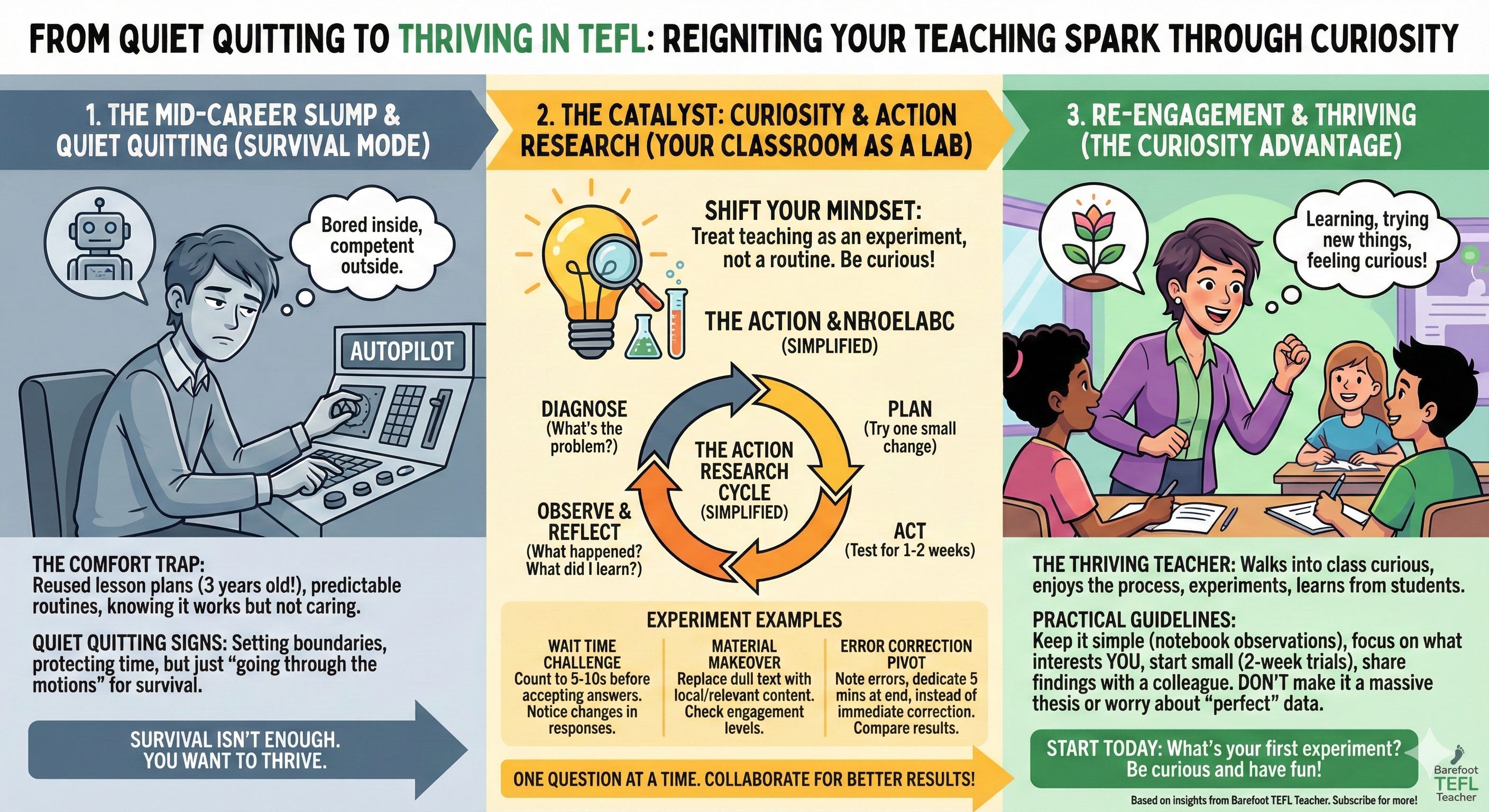
Back in June 2024, I wrote about the 9 signs of quiet quitting in TEFL. Teachers reached out saying “that’s me” or “that’s my colleague” or even “I didn’t realize I’d been doing this for five years already.”
What I didn’t talk about in that article is what comes next.
Recognising you’ve quiet quit is only half the battle. The real question is, what do you do about it? How do you go from autopilot to actually caring again?
You didn’t get into teaching to coast along. You got into it because at some point, you loved it, or thought you would (hopefully you still do!).
So what happened?
The mid-career slump is real
Teaching, especially language teaching, makes it easy to fall into a rut.
You find activities that work, you know what students respond to. You’ve got lesson plans from three years ago in plastic wallets that you can reuse. You could error correct the present perfect in your sleep (and sometimes you do).
This is what a comfort trap looks like.
From the outside, it looks like you’re really good at your job. Your lessons run smoothly, students learn, and you meet your contract. But inside? You’re bored as hell.
You’re on autopilot, just going through the motions until end of the day.
The worst part is that you know what good teaching looks like. You’ve read the books, been to the CPD sessions and you know about student engagement, differentiation, formative assessment, the lot.
But somewhere between knowing and doing, you lost the energy to care.
This is the mid-career slump and it’s more common than folks want to admit.
When survival isn’t enough
Quiet quitting is a survival strategy. And it works - for a while.
Setting boundaries is healthy. Protecting your personal time is essential. Not burning yourself out for a job that doesn’t appreciate you? Absolutely the right move.
But survival isn’t the same as thriving.
If you’re reading this, you’ve probably reached a point where surviving isn’t enough anymore. You want to actually enjoy your job again. You want to walk into class feeling curious instead of resigned. You want to care.
The question is: how?
Your classroom as a lab
In January 2025, I wrote about Action Research for language teachers. I talked about it as a professional development tool, a way to improve your teaching through experiments.
What I’ve realised since then is that Action Research really about curiosity.
Think about what made teaching exciting. It probably wasn’t the idea of doing the same thing, the same way, for thirty years. I’m guessing it learning and trying new things. Of trying a new class that scared you, initially. Of seeing what happened when you switched things up.
That’s what Action Research can give ya.
When you treat your classroom as a place to experiment, teaching becomes interesting again. And fun! All because of curiosity.
What classroom experiments actually look like
Before anyone says it, I know it sounds like more work. It’s not, I’m not saying write a thesis or publish in journals (unless you get super keen).
I’m talking about small experiments that make your teaching more interesting and are actually fun to do.
Here’s what this looks like:
Experiment 1: The wait time challenge
You notice students aren’t talking much when you ask a question. You wonder, what if I wait longer after asking questions?
Week 1: You count to 3 in your head before accepting answers. Week 2: You count to 5. Week 3: You count to 10.
You observe what happens. Do more students raise their hands? Do answers get more thoughtful? Does the silence feel uncomfortable or generative?
Boom, research in action.
Experiment 2: The material makeover
You’re bored with your reading materials, and you’re pretty sure your students are as well.
Week 1: You teach a reading lesson with a coursebook text about “environmental issues” (generic, impersonal, dull). Week 2: You teach the same grammar/vocabulary using an article about a local roadworks happening down the street.
Which lesson had better engagement? Where did students ask more questions? Which vocabulary stuck?
Experiment 3: The error correction pivot
Students keep making the same mistakes with past tense (they must be morons, can’t be me!), and your corrections don’t seem to stick.
Current method: You correct errors immediately during speaking practice.
New approach: You write down errors during the activity, then do a 5-minutes at the end to work on it.
After two weeks, you compare: Are students making the same errors? Do they seem more or less confident speaking? What changed?
One question at a time
The beauty of Action Research is you don’t need to revolutionise your practice.
You just need one question.
What if I tried X instead of Y?
What happens when I change Z?
Why do students respond better to this than that?
Pick one thing that’s bothering you. Get ideas from colleagues. One problem you keep seeing. Then try something.
The action research cycle (simplified)
If you want to be slightly more formal, here’s the basic cycle:
1. Diagnose - What’s the problem? (Be specific: “Students don’t speak much” becomes “Students hesitate to answer in front of the whole class”)
2. Plan - What’s one thing you could try? (Don’t overthink it. Pick something reasonable)
3. Act - Try it for 1-2 weeks (Long enough to test it, short enough to keep momentum)
4. Observe - What happened? (Take notes. Record impressions. Ask students)
5. Reflect - Did it work? Why or why not? What next?
The crucial part: you don’t need it to work perfectly. You just need to learn something.
If your experiment fails spectacularly, great - you just learned what doesn’t work in your context. That’s valuable.
If you want structured guidance to help you, my Reflective Teaching Journal is designed for this.
Some ideas
Rearrange your classroom layout to see what it affects
Start each lesson with a 2-minute story
Use dialogue journals with shy students
Implement a “no hands up” policy where you randomly select students to answer. Or do the opposite.
Create a weekly “experiment slot” where students suggest activities they want to try
The specific experiment matters less than the mindset shift, ‘cos you’re no longer stuck. You’re investigating.
The collaboration advantage
One thing I didn’t say enough in my Action Research article: collaboration makes this sooooo much better.
Find one colleague who’s also feeling bored. Compare experiments, share what’s working. I’ve found before that this simple act can spread, and soon the whole staffroom is trying new stuff.
Even better: involve your students. Ask them what they think. get feedback, help you experiment on them.
When you do this, two things happen:
The experiment becomes more interesting (you have someone to discuss it with)
You feel less alone (quiet quitting is isolating)
Practical guidelines for busy teachers
Do:
Keep a simple notebook for observations (bullet points are fine)
Choose experiments that genuinely interest you (not what you think you “should” be doing)
Start with two-week trials (short enough to be manageable, long enough to see patterns)
Give yourself permission to abandon experiments that aren’t working
Share your findings with one trusted colleague
Don’t:
Turn this into a massive research project with formal data collection
Experiment with everything at once (one thing at a time)
Beat yourself up if an experiment fails
Worry about whether your findings are “scientifically valid”
Add hours to your workload - this should fit within your existing teaching time
Start today
Here’s a weird way to think of it - your students are already giving you data about what works and what doesn’t, but you may not be listening.
Are you noticing patterns, asking questions or testing ideas?
Choose to be curious, and have fun!
What’s your first experiment going to be? I’d love to hear what you’re curious about -comment below and tell me.
If you liked this article, you’ll love my books:

📝 Lesson Planning for Language Teachers - Plan better, faster, and stress-free.
👩🎓 Essential Classroom Management - Develop calm students and a classroom full of learning.
🏰 Storytelling for Language Teachers - Use the power of storytelling to transform your lessons.
🤖 ChatGPT for Language Teacher 2025 - A collection of AI prompts and techniques to work better, faster.
💭 Reflective Teaching Practice Journal - Improve your teaching in five minutes daily.