

How to choose between PPP, ESA, TTT, and TBL
A thirty-second decision that doesn't need to take thirty minutes.
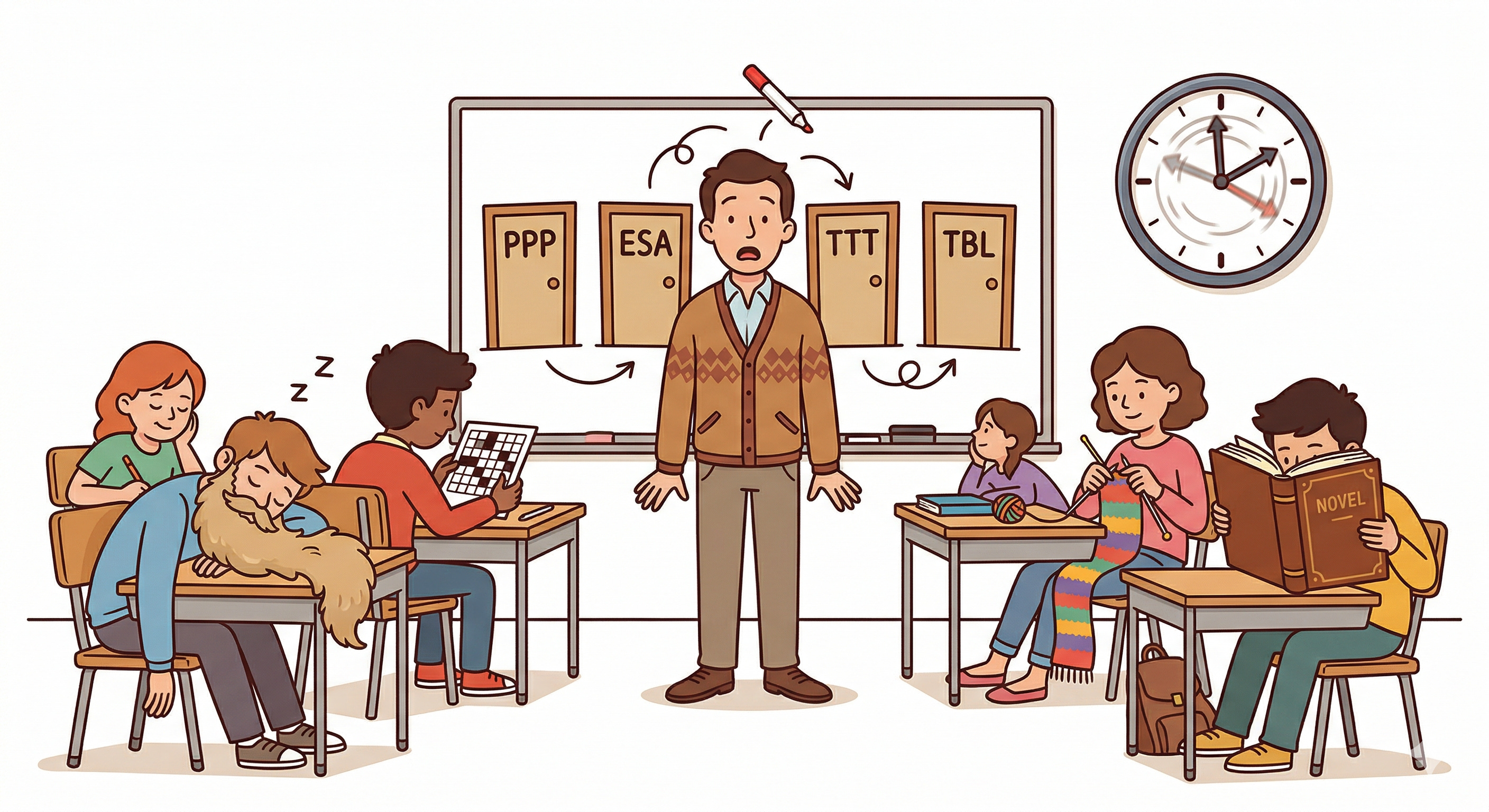
I remember sitting in a teacher training input session, notebook open, genuinely convinced that choosing the wrong framework would ruin a lesson. PPP felt safe but limiting. TBL felt exciting but risky. ESA felt like a compromise. TTT felt like cheating somehow - like I was admitting I hadn’t planned properly.
That was a long time ago. I’ve since planned and taught thousands of lessons, observed hundreds more, and trained teachers across a range of contexts. And the honest truth is that the framework question matters a lot less than we’re taught to think it does.
Here’s how to make the decision quickly.
What each framework is actually for
Not the textbook definitions - the honest version.
PPP (Present, Practise, Produce) is for new language with learners who haven’t encountered it yet. You introduce it, you drill it, you let them use it. Simple. Effective when the conditions fit.
TTT (Test, Teach, Test) is for language your learners might already half-know. You find out what’s there first, fill the gaps, then check again. It doesn’t assume ignorance.
TBL (Task-Based Learning) is for when the communication goal matters more than the language point. You set a task, they do it, you look at what came up, you work on it. It’s messier to plan but it mirrors real language use.
ESA (Engage, Study, Activate) is less a sequence and more a container. It can hold any of the above. The stages don’t have to run in a fixed order, which gives you room to adapt mid-lesson.
One question that cuts through it
Before you write anything on your plan, ask yourself: do I know exactly what language I’m teaching, and am I confident my learners don’t know it yet?
Yes - use PPP.
They might already have some of it - use TTT. Start by finding out what’s there.
The goal is communication, not a specific language point - use TBL.
You’re not sure, or it’s a mixed group - use ESA as your frame and adapt as you go.
That’s the decision. It doesn’t need to take longer than thirty seconds.
Why we overthink
Training courses present these frameworks as if they’re in competition. You study each one in turn, you’re asked to identify which one you’re using, you get feedback on whether your stages match the model. The message - even if unintentional - is that there’s a right answer.
Lesson observations reinforce it. “What approach is this?” is a reasonable post-lesson question, but it can leave you feeling like your forty-five minutes had to commit to a single philosophical position. In practice, experienced teachers blend all of these instinctively and rarely stop to name what they’re doing.
The frameworks were always meant to be tools. Somewhere along the way, they became orthodoxies.
The observer problem
If you’re being observed - especially on a training course - the framework does become a real constraint. You’re expected to be able to name what you’re doing and justify it. That’s fair enough. It’s part of learning to articulate your practice.
But even then, the decision doesn’t need to be complicated. Pick the framework that matches your lesson aim, plan your stages clearly, and be ready to explain your reasoning in one sentence. “My learners haven’t seen this structure before, so I’ve gone with PPP to make the input clear and controlled.” That’s all you need.
The observer wants to see that you’ve thought it through - not that you’ve agonised over it.
When you’re genuinely unsure
Pick the one you can plan fastest and teach most confidently.
A well-taught PPP lesson beats a half-baked TBL cycle every time. If you’re new to a context, default to PPP or TTT. They’re easier to plan, easier to manage, and easier to reflect on afterwards. TBL comes in as you get more comfortable. That’s how most teachers develop, and there’s nothing wrong with it.
The thing that actually matters
The goal is for your learners to leave the room having used English in a way that stretched them. That’s it. The framework is scaffolding - useful while you’re building, invisible once the lesson runs.
Pick the tool that fits the job, plan it well enough, and get on with teaching it.
If you liked this article, you’ll love my books:

📝 Lesson Planning for Language Teachers - Plan better, faster, and stress-free.
🤖 AI for Busy Teachers - A practical guide to save hours every week.
👩🎓 Essential Classroom Management - Develop calm students and a classroom full of learning.
🏰 Storytelling for Language Teachers - Use the power of storytelling to transform your lessons.
🤖 ChatGPT for Language Teacher 2025 - A collection of AI prompts and techniques to work better, faster.
💭 Reflective Teaching Practice Journal - Improve your teaching in five minutes daily.